TestBash Brighton 2016: Homecoming

Conferences

TestBash is the Mecca for testers around the world.
I have been wanting to go for a long, long time. It’s got a ton of interesting, great people who are, on top of that, highly experienced and motivated testers!
Alas, this year, I wasn’t going to make it. Weeping, I looked forward to the twitterstorm that would leave me somewhat involved and envious of the people who were able to attend.

Wednesday

Then, Steve happened.

Completely by surprise, the news of me being able to go to TestBash2016 swept me off my feet: unprepared and unplanned a spot just opened up for me.
I have Steve Green from TestPartners (London) to thank. A colleague of his wasn’t able to make it and Steve decided to bestow the ticket to a tester he deemed worthy.
I got lucky, as I was apparently the only tester available who could clear his schedule.
A free test bash ticket and a hotel to spend the night were mine to enjoy.

Thursday

By the time I drove to Brighton, I knew more about Test Bash than I needed but much, much less than I wanted to.
That evening, I wandered the streets of Brighton in search of testers who I’d recognize from Twitter and/or Slack profile pictures or tried to pick up flashes of test-speak.
Needless to say, that tactic wasn’t too successful.

After some frantic twittering and emailing, I finally got the coordinates to some covert, next-to-the-beach pub that had an open bar, about 200 testers and plenty of discussions ranging from forehead-tattoos and the most funny bug people had uncovered.
I got drawn right in. It felt like homecoming. Everywhere I looked I saw faces of people whom I’d chatted with, read blogposts from, had reached out to and had shared ideas with.
It was like seeing your family again, after being abroad for way too long.

I was there for about two beers time and met so many people I wanted to compliment and thank for the impact they’ve had on me as a tester.
Rosie, Richard, Vernon and Huib were the first to greet me. They introduced me to several other new people I had already met, but hadn’t recognized.

Anna Baik, I wanted to thank for her involvement on the Tester Slack group and her guarding of the integrity of the community on that channel, even if it’s easier to disregard people who ask the wrong questions. So I did. And I hope it sounded much more earnest in person than it would do over twitter or chat.

Helena Jeret-mäe, I thanked for helping me with creating a proposal for Let’s Test. Even though I didn’t make the cut that time, she told me what she appreciated about my effort, what could be better and on top of things, she gave me two more challenges. The first, I completed a day later: “Participate in the 99-second talks”.
Furthermore, she told me of her experiences and why she does what she does, further motivating me to make my own kind of music.

Friday

Eight hours later, I woke up to the sound of seagulls. Brighton! Right! pre-TestBash run, Let’s go!
Seven other crazy runners and me jogged along the Brighton coastline for a few miles and talked about each other’s Test work and sporting goals.
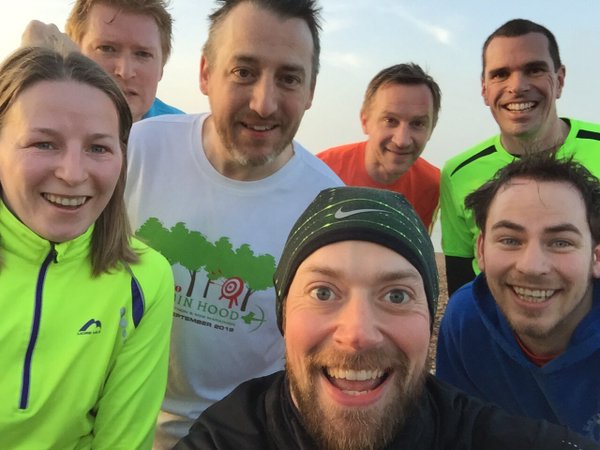
CdQAew1UYAE_QByIt’s a fun tradition that cleared my head and sharpened my mind for the whirlwind of a day to come.
Full English Breakfast, with capital letters, was enriched by getting to know my benefactor, Steve Green and his colleagues. If I ever consider working in London, his shop would be my place to go. During the course of a breakfast it became clear our ideas about testing are very aligned.
If you’re looking for a test gig in London and are tired of mindless testing and rigid processes, contact Steve. Really.

The conference had yet to start but my expectations were already met. I had met great people. Steve and all the people from the day before would have left me satisfied for a long time.
It had only been the beginning…

I made it a point to not linger too long with the same person, so as to not miss to many others. I was there to connect, thank, appreciate and get to know other testers  and set a foundation for later interactions.
I met a huge number of people whom I’m looking forward to get to know better. Time did not permit more than that.

Apart from the great interactions with incredible people there were of course, the conference talks.
Two of these really stood out for me. Katrina Clokie’s experience report of organizing pairwork in her company struck a chord with me. Not because she told us the advantages pairing bring, but because of her methodical way of organizing, iterating and improving upon it. Katrina is a big personality through her modesty and a huge asset to the testing community.

Bill Matthews’ talk had me shivering in my seat. He started with a fun, entertaining demo of not-so-smart, smart algorithms. Do you know the “Calculate my age from my picture” or “which dog is on this picture” algorithm? Played around with it?
Funny, right?
Well, imagine algorithms like that controlling your car or calculating what the maximum price you’re willing to pay for your train ticket fares would be. Imagine them influencing the way you think, buy, make decisions,… the way that marketing does.
Scary, huhn?
How would you test these algorithms and the effects the have?
It gave me the willies , I tell you.

Between talks I met another tester, who’s hometown I share. It was his first Testing Conference and it was clear that a whole world was opening up to him. I’ll be seeing more of him, I’m sure.

I could write many, many more stories about these very limited hours and I could elaborate on the ones here a whole deal more.
If you have read this far, you probably already got the message:

Attend
TestBash

Really.

Capture

DEWT, where’s the bar?

Conferences

For those not in the know, DEWT (pronounced similar to “dude”) is the Dutch Exploratory Workshop on Testing. It’s a peer conference and “boy, a hell of a lot of fun!”.

Feelings beforehand

I was incredibly nervous driving towards the conference. I knew no one. The next 48 hours would be spent with 25 total strangers.
On top of that, there was a chance I’d had to present my experience report. Everyone had to prepare an experience report in advance, with the possibility of presenting it. After these presentations, rigorous and in-depth discussion would ensue.
In my mind’s eye, I saw my ideas torn to pieces by highly critical, well versed testers.

As a tester, I felt curious. I had heard and read a lot of good things about peer conferences. Yet, many stories tell of ‘peer-conferences-gone-bad” as well. (I learned a few extra during DEWT as well.) I wanted to know what takes place, how it’s organized and how the atmosphere felt. It turned out to be incredible experience that was surprisingly embracing.

I’m caught. I feel energized, backed up, and dizzy from all the ideas going around in my head and butterflies in my belly. I got to know so many interesting and lovable people. Each one of them brought something different to the conference and everyone’s perspective was heard, nay, absorbed.

I’m a firm believer that you can’t put 25 people of any other same profession together and experience a likewise challenging, passionate, engaging, yet open and friendly surge of energy as I did this weekend.

The Bar

I was terribly late. Traffic, you see. But I was lucky the organizers saved me a plateful of food.
A few minutes later, I was talking with three other testers on our way to the bar. They were telling me all about their current project, how they became a team and how they are still improving.

I listened and asked questions. I felt right in.

At the bar, beers were provided and games were conjured. The hotel provided everything we could possibly need. Snacks were brought before you knew you could do with some food and whatever drink you liked suddenly appeared in your hand a few moments later.

Before long, we grew closer together, in a safe environment filled with laughter and like-minded people. Not a worry around us.

I fell asleep just before my head hit the pillow.

Day one

What followed, was a full day of presentations and discussions. Everyone pitched in and offered help, a unique viewpoint, books, podcasts, articles and plenty of other triggers.

Most of what was discussed that day will seep into my every day test work over time, I’m sure.
Even today it dawned on me, that where I am working, even right down to the team I am working with, is suffering from a syndrome Ard Kramer laid bare that day. Ard’s presentation was about communicating risk, but what struck me today was a particular slide handling “meaning vs. systems”.
I’ve only been a month at my current project, but have had weekly “process improvement meetings”. Yet, no “value” or “meaning” or “purpose” meeting was had ever.

I had never looked at it that way. Ard showed me and he gave me a tool to communicate it.

The presentations where varied and each gave a different dynamic to the group discussions. I remember Susan’s presentation fondly about a shared responsibility problem and the coaching, understanding and kind words that followed. Or Joep’s presentation that talked of a success-story of some sorts but had a few people’s emotions (my own included) flare up for various reasons. Another presentation by Thomas had us all awestruck by it’s compelling and comprehensive mindmap, listing all the different dimensions of communication.

Day one was long and full of learning. It ended with Michael Bolton visiting on the way through, him playing his mandolin and a group performance of “500 miles”.
Whiskey tasting, party snacks, good beer, good talks, great music and perfect company.

Day two

Nothing much seemed changed on Sunday. Never change a winning team, right?
That’s what we thought…

Until chaos unravelled. Sweet chaos.
After a talk by Femke and Philip about pair testing and how they learned to interact with each other, it was Joep’s turn again.
Apparently, he had decided he had played enough with our feelings the day before. Today, he’d f*** with our minds.
He didn’t have to try too hard either, I guess…

“A workshop”, he told us. “A workshop that will combine all the different things you learned this weekend into one big mindmap. And I’ve got just the way to do it!”

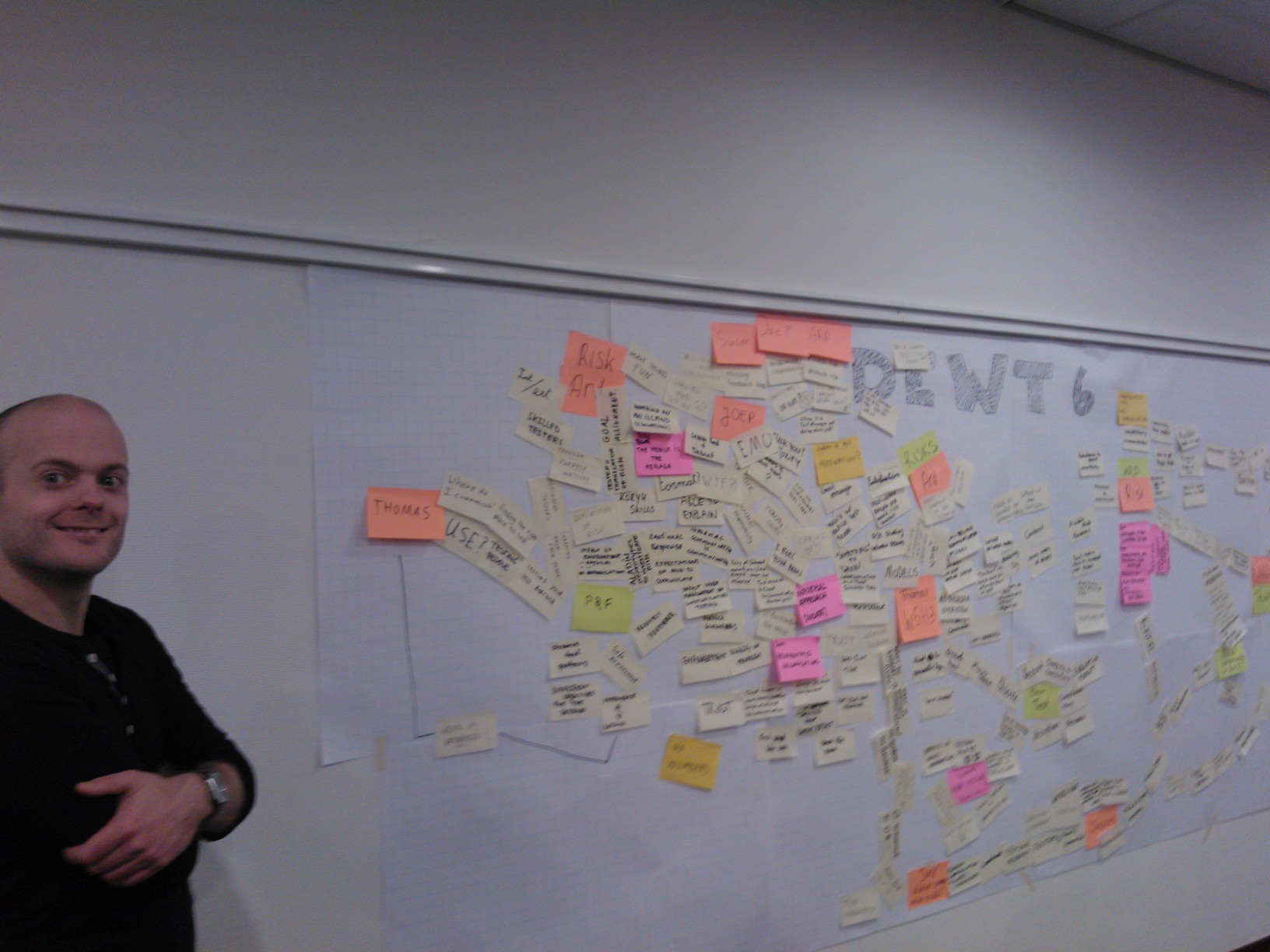
Have you ever tried to build a mind map with another person? Have you ever done it with five? Have you ever combined four five-person mindmaps together?

Well, we did. And it wasn’t pretty.
It did get us to think about how everything fitted together and how everything we touched upon was linked.
Even though it might not look like it on a wall, it did in my head.

Thank you

These past days have left me invigorated, gave rebirth to old ideas in a new light, generated new ideas, provided fond memories and newfound friends.
What else could a person want?WP_003561

The BBST Foundations course: Week 4

Experience Reports, Software Testing

The Final Week

It’s the monday of the last week of BBSt, I flunked the last assignment and that had angered me.
In fact, this released a lot of the frustrations I had towards the course in one moment.

I had a short discussion with the instructor and this cleared up a few things. I hadn’t quite understood in what way I had to explain my answer and the instructor hadn’t found what I wanted to say.

We had a long google-hangout session and cleared a lot of things out. Apparently, there were a few videos and pages I missed that were key to answering the exam successfully.

For example, there’s a list of keyword. If the question contains “List X” you give 3 examples of that list. Number 4 and number 5 will be ignored, unless they contain errors; in that case, they’ll subtract marks.
Another, If it says “Describe”, you have to paint a picture. “Describe the Weibull curve” becomes: “A fast surge in the beginning, a flattening until it reaches the peak and then a deep plummet down until its pace declines and steadily, but slowly falls down to 0.

So yes, you need to know these things to be successful in the course. No, it has nothing to do with testing, apart from the fact that “precision reading” is a core skill of a tester.

I eventually got to fill out all the exam questions and discussed several answers of the other students.
I tried to be everywhere and discuss everything worth discussing.
In the end, there was a lot less activity this week than all the others.


The Exam

The exam was a three day, closed book exam. The instructors count on your honour not  to cheat. But it’s really easy to cheat. Really, really easy…. And we’re testers.
Testers cheat.

I had everything stored locally. All my answers, all other people’s answers, all the quizzes…
My book is full of post-its with all the definitions and important information on it.

I really like cheating, I do.
Yet somehow, I was able to fight the temptation. My honour is unscathed. This is probably because I didn’t really need it. I had answered every question already before and I had done this meticulously. I was pretty confident in my answers.
Apart from that, during the exam, you experience sparks of brilliance. You think of things you weren’t able to before.

Gabi, the instructor, had told me that might happen. I didn’t believe it, but paid attention to it none-the-less. He was right.

After the Exam

Ru, another instructor, and me went over my exam questions in a Skype meeting. She had lots of feedback and gave me an appreciation for my answers.
Even-though there was a question in the pool which I had answered similarly wrong as the practice question, Ru gave me the chance to defend and change my initial answer.

The conclusion in the end was:

  • I have successfully completed the course
  • My exam met expectations
  • I was one of the most active students across many foundations courses.

Aftermath

I have already stressed how interesting the material is and how much I’ve learned from the course. It’s good. The course is by far the best testing course I’ve learned about by now.

If you’re looking to send your testers on a course, take this one.
Really.

There’s a few things I didn’t really like though, but I can see why they are the way they are and how they each have their own function.

  1. I disliked my experience of the online component.
    While I really like functioning in diverse teams, I absolutely disliked it in this format. Don’t get me wrong I really liked the people I met and got to know. Maybe someday, we’ll meet again. But generally, I felt it was a distraction. Every task is focused on the individual, with the option to give feedback on others.
    Most of this feedback is about questions. “Why did you say/do it like that?”. You ‘lose time’ explaining your words and ideas, rather than have an in depth discussion.
    Sure, this is how it works in the real world. But I get enough of that in the real world already, here I want to learn and learn in depth.
  2. I disliked the Exam format.
    To me, the exam is not a good representation of “did I make the course or not”. It serves two functions: One; it’s a learning opportunity. A way to further process what you’ve learned. Two; it’s a measure of how well you completed the course.
    I felt it focused way too much on precision reading and precision writing than on what you’ve understood from the course.
    It’s very academic. I understand why, but that doesn’t mean I have to like it.
    I would really like to know how many from my class got their ‘certification’. That way I could take a guess at how high I should hold it in esteem.

I have felt frustrated throughout most of the course, but I have learned a ton.

Thank you, Cem, Altom, Ru, Gabi, the other instructors and all my fellow students for your efforts and knowledge sharing. I imagine I wasn’t the easiest student, but I’m grateful for the chance of learning with you.

The BBST Foundations course: Week 3

Experience Reports, Software Testing

I have the feeling I took the week off.
Did about 15 hours of work towards the course, but there were too many other things going on, rendering the experience of the course a bit too the background.

A lot has happened though. All the assignments are completed, all quizzes are done and all deadlines passed. Next week is a straight line to the exam.

An online meeting

Last week started off with a Google hangout session where about 10 people gathered, including the instructors and Cem. It was interesting to see how this format was handled. The value from the session was that I could finally see and interact with the people apart from a forum setting. I got to know how some people talked, looked and generally carried themselves.
I found that I really benefit from having seen people in order to understand their communication better.

This was an hour to ask anything to the instructors directly.
There were less questions than I expected and the explanation to them couldn’t quite go as much in depth as one would like. It’s probably very hard to divide the time among the relevant questions and make sure the important things get covered without going too much into details.

Next up: practice exam question.

All the exam questions are there. All twenty of them have been sitting there from the beginning of the course. I’ve understood that we’ll get a subset of those for our final exam. So everything can be prepared perfectly in advance.

However, one of the final assignments is prepare a bogus exam question. This exercise is meant to practice how we should tackle the questions. It is designed to teach us how to format our answers and explain them in a clear and structured way.

I didn’t do well on this exercise. I could’ve put more structure in there, worded it more precise and more elaborate.
It’s definitely a skill I have to practice if I would pursue the other BBST certificates.

One week to go.

I’ve got more than enough time to work trough the exams. Hell, I’ve completed 3/4’s already.
I hope the other students and instructors have enough energy left to make this last week one for the ages.

The BBST Foundations course: Week 2

Experience Reports, Software Testing

A blast, a long sizzle

This week started with two days of never-ending stream of comments. I did a quick arbitrary count and think the whole class generated close to 200 messages during that time.
That’s a lot of input you can work through. ‘Can’, because you have a choice. I’ve skipped more than half of the messages and read only a few in depth.

That’s because most of the messages are the same, yet framed in a different way. They are all answers from the students to two or three exercises and can be expected to be very similar content-wise.
The exercises are challenging, interesting and make you see things somewhat different. Excellent for new testers, or testers who have been doing their job the same way for a very long time and are looking to shake things up a bit.
Yet again, the online format gives a lot of input, but brings very little extra.

The people who read last week’s blog post will have noticed that I was struggling to adjust to the format of the course. I decided to mailed two different instructors to explain my situation, what I’m thinking and how I perceive things.
When I didn’t get any reply from them (I can imagine they get a lot of these inquiries), I contacted Ru directly on the tester’s slack. (check it out if you haven’t yet!)
She gave me much needed feedback for which I’m grateful.

After the big bang of messages, everything turned suddenly very quiet for 4 days. One or two messages a day, nothing more. I’ve been solving the exercises and storing them locally, deliberately not putting them on the forum yet. Trying to not seem the try-hard I am.

Where I’m at in the course

This week I worked about 25 hours on the course, the week before will be close to 30.

Week 3 begins tomorrow and I’ve worked through the course almost completely, listened multiple times to the lectures, completed all the quizzes, created a glossary and completed all but one assignment.

What I still want to do, is make a summary of all the lessons, listing the lesson objectives it touches upon and do some sense-making of what’s behind the course. I’m pretty sure that will prove valuable.
Apart from that, I’ll focus on the 20 exam questions and figure out what the instructors want (and don’t want) to hear.

I’m trying to find just the right amount of questions to ask and assumptions to make because I’m getting quite a few mixed signals. For example:


If you were to frame the context this way, then what you’ve included in your answer would be the absolute best way to address this context.
But I also feel you would get more learning value out of the course if you would try to work with the information that is provided rather than fight it at every turn.

(These are snippets from feedback I have gotten, not the whole thing. I include this here as an example, but it’s take out of a much larger body of feedback and so, is out of context.)


I don’t know what to do with this.
It’s a context driven course. I put myself in that context and try to make that context clear(er) to me. The instructor tells me that I did good in my answer, but at the same time tells me to stick with the information provided.

In any case, even with all the ups-and-downs, I’m having a blast. Today, Cem Kaner gave feedback on some of my exam questions and I have to do my absolute best to counter-argue. That’s learning.