We-Were-Testers

Complaining

I’m writing this from my hotel room in Stockholm, after attending and conferring at Eurostar 2016. I’ve thoroughly enjoyed it and was able to meet so many different and passionate testers from places I didn’t even know had testers.

But this experience was somewhat spoiled by something completely different.
Here’s a few things that get me all riled up: Pokémon that run away and injustice. (amongst other things)

Today I’m complaining about injustice.

The Context

This injustice comes from a source that I had hoped valued integrity and transparency as much as it marketed to be: We-Are-Testers.com. (WAT)
They provide a service, like many other crowd testing companies, that links a customer with specific needs to a number of testers who are willing to jump at the opportunity to test something new AND make a few extra bucks while doing it.

I welcome this idea as it offers me the chance to do some extra testing, but also get some pocket-money to spend.
This mission, I had two days time to test an application on an Iphone and come up with linguistic issues in it.

Pretty easy right? Especially because all the Dutch text I had to review seemed to be copy pasted from a Google translate service.

However, some constraints hindered me: Only two days of testing were foreseen and the first day I spent an hour trying to install the app, only to find out the configuration of the install thingy didn’t work for me. An admin from WAT had to correct this for me.

The second day I was able to test for two hours before the deadline.
I logged 18 bugs, which would amount to maximum 144 EUR.

how-to-report-bugs

All required fields were filled in, as per agreement. Steps, expected outcome and actual outcome were all given as well as any other required fields. (How else would I be able to submit the bug?!)

Later, the next day, mails came flying in. INCOMPLETE, INCOMPLETE, INCOMPLETE.

Wait a second, there seems to be something wrong…
I hadn’t included screenshots.
Ok, I agree that a screenshot is pretty handy to have in most bugs.
HOWEVER, in this context, with two hours time to find as many bugs as possible, making, uploading, downloading, linking,… screenshots would heavily cut into my bug-finding time.

Steps, the name of the screen where the bug was found, the actual text and what it should become had to be more than enough for meager text issues.

In any case, for the three hours of work I wouldn’t see a penny.
And me being me, I kind of want to make a problem out of that.

Gathering evidence

payment-policy how-to-report-bugs

The Discussion

I contacted the moderators and spokespeople from WAT, who are generally really nice guys and girls, to ask them to look into my situation.

Argument 1: Their website’s “Payment Policy” doesn’t mention Screenshots are a requisite for payout. It specifically says attachment only if relevant.

Argument 2: The mission’s “How to report a bug” doesn’t mention Screenshots are a requisite for a complete bug.

Argument 3: If Screenshots are a necessity for this project, please please please make the input field for screenshots a required field?

This is a clear miscommunication, so I gave them time to find out how they’d handle my situation.
Today I heard that I wouldn’t get a dime for my efforts, that it was unfortunate but that it was virtually my own fault.

reply

My point is not whether screenshots should or shouldn’t be added to bugs.
My point is that WAT is telling me I should not be paid because I didn’t adhere to a rule that I can’t find anywhere in their Terms of Agreement, Payment Policy, FAQ or Mission Description.

They did offer four extra hours to insert the screenshots. At noon. While I’m at work. Thanks a lot!

They argue that the devs need screenshots, but frankly, that’s not my problem.
WAT provides a service to the devs. I provide a service to WAT.

WAT should carry the burden of handling communication errors on their part,
And I shouldn’t be the one to suffer from the gaps they leave.

I’m pretty sure those bugs will be fixed in the next version. But regardless of that, not paying people because of rules applied by a third party seems kind of illegal to me.

If you don’t agree, let me know.
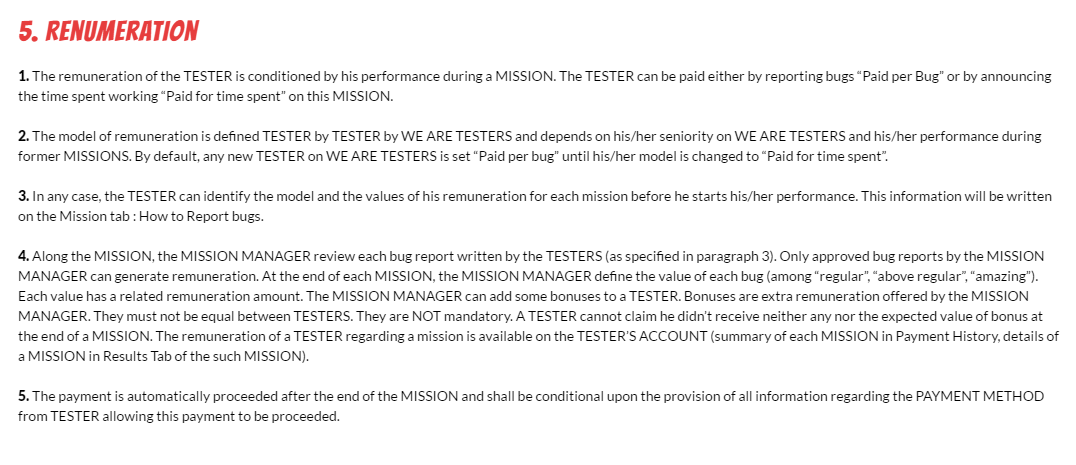
remuneration

Consult the TestSphere

TestSphere

Last Friday was TestBash Manchester and I’ve enjoyed it thoroughly.
The talks are inspiring, the organisation is impeccable, facilitators are the friendliest people ever and then there’s the people that attend:

All these speakers, listeners, organizers, attendants,… make you feel right at home.
They are what make every edition of Test Bash legendary.

This time, I got the privilege of meeting a whole ton of them while handing out a new card game Rosie and me put together.

testsphere


TestSphere: The tool

TestSphere is an idea that has been worked on for two years, has seen 5 different implementations and eventually came alive as a 100-card card deck.

A hundred cards, each featuring one keyword that has something to do with testing.
This keyword is further explained with:

  • A category:
    • Quality aspects
    • Techniques
    • Heuristics
    • Patterns
    • Feelings
  • A slogan
  • Three examples of how this keyword could impact your testing

That’s it! One hundred cards full of test-vocabulary and inspiration.
Can you already imagine how you could use that?

testsphere

TestSphere: The Ice Breaker

Step 1: Spot a lone tester
Step 2: Walk up to them and draw a random TestSphere Card i.e. “Equivalence Partitioning”
Step 3: Ask: “How has “Equivalence Partitioning” affected your testing? Do you have a story or experience to share about that?

What follows is that person thinking a few seconds and eventually give you an interesting story that is the beginning what possibly is a good discussion on that keyword.
Another thing that could happen is the person not understanding what you mean. This gives you the opportunity to practice explaining your testing.
Either way, you’ll have started a discussion where you can coach, teach and learn at the same time.

Additionally: Just keep the cards on your desk at work. Developers, Business people, Managers who come to your desk will say “Ooh, shiny colours! What’s that?”.
Before you know it, you’re teaching your coworkers a thing or two about testing.

testsphere

TestSphere: The Storytelling Game

Step 1: Find a group of 4 to 8 persons
Step 2: Divide the deck by category (20 cards each)
Step 3: Depending on the experience of the group: reveal one or more cards
Step 4: As soon as one person can think of a story that features all revealed cards he or she knocks on the table
Step 5: Tell the story
Step 6: This person takes the revealed cards as full points
Step 7: Other people can also tell their stories to get unrevealed cards for half points.

The person that gets X points first or most points by X time wins.
Easy right? You’ve just gotten a whole group of people thinking deeply about their previous testing experiences and put those experiences to verse.

Additionally: After or even during the game identify opportunities for coaching and helping the others. Point them to resources or people who might help them get more insight.testsphere

TestSphere: The RiskStorming Game

The RiskStorming game is a visual, collaborative method to map your Test Strategy on threats to the quality aspects that matter.
The game consists of three phases:

  1. Select a subset of important quality aspects, blue TestSphere cards. (The things that matter)
  2. Come up with risks to the selected quality aspects. (Threats to the things that matter)
  3. Use the rest of TestSphere to create a strategy in function of those risks. (Test for the threats that impact what’s important)

It is explained much more in depth here: http://thatsthebuffettable.blogspot.be/2017/11/riskstorming-maping-risks-with.html

Also, at the bottom of that blogpost are printable boards for RiskStorming!


IMG_20171025_210001.jpg

TestSphere: The Unblocker

So you find yourself bored, blocked, sad or stuck?
The best thing you can do at those times is learn something new.

Draw a random card.
Can this idea infuse your testing in a new way?

  • Have you tried the “too many” heuristic?
  • Have you tested the “Accessibility” Quality Aspect?
  • Could you try doing some “Pair Testing” Techniques?
  • Try exploring your product by applying “force” in creative ways.
  • How would an “Irritated” or “Angry” user use your application?

Additionally: If you don’t know the word on the card, or feel you don’t know if well enough: try to find more opportunities of learning about the concept!

testsphere

TestSphere: Unlimited Possibilities

Job interviews, Brainstorming, Lean Coffee, Analysis tooling, Visual connecting concepts together, Exploring opportunities for personal growth, Storytelling without using keywords, Generating random Test Persona, Re-categorizing the whole thing and connecting the words using different logic,…


TestSphere has been deliberately kept free from rules. I believe testers are creative enough to find use cases on their own and decide for themselves which ones are valuable and which are not.

The only constant is learning from stories and experiences. From your own and from those around you.

We’re not quite ready for mass distribution. We’re still feeling out the market.
However, there will be an option to pre-order one or more decks in the future.

Be sure to hear about it at: @TestSphere

cvxoqo7xeaanmez

Software Intelligence

Software Testing

In preparation for my Eurostar Conference talk, I’ve been researching quite a bit into learning behaviour, experiential learning and social behaviour. More CGJungspecifically, the ideas of: Jung, Piaget, Dewey, Lewin & Kolb.

Each on their own they already offer a wealth of knowledge. Combined… well, it’s been an interesting year so far. So much information, so much to process.


This post is not about what I’ve learned, it’s about what is currently going through my head and what I need to put to pen.

Reflection

Triggered by all that research, I’ve been doing a lot of introspection lately. Who I am, what I want to achieve, how I fit in the project puzzle and what I find important in my working environment.

Some examples of recent milestones that pushed me to my current mind-set:

  • My fellow tester and me have both done an MBTI test and discussed the pains and gains of our professional relationship based on the results.
  • During retrospectives we’ve been asking directly for feedback of how the team might benefit more from our efforts.
  • A team member called me ‘just a tester’ and I had to tackle that. Even though it was said ‘in good fun’ you can’t accept such remarks lest they become reality.
  • I’ve made a list of all the activities I do, how important I think they are, how important I think they are for the team and how much time I spend on them.

The result of that list is that I spend 1/3rd of my time on actual testing. Another third is spent supporting the team in various ways: Communicating, coordinating, prioritizing, delegating, increasing involvement for team members,…
The last third is reserved for change management, monitoring, communicating with business and more activities that are more business and project management facing.

Am I a software tester? Absolutely.
Am I an important point of contact for business? Yes!
Am I a team psychologist? At times.
Am I a coach, quality advocate, release manager, gatekeeper,… ? Yes, whenever the project needs me to be one.

What do you call all this?

This way of thinking leads me to believe that Software Testing is not the best way to describe our efforts. At least, for my current context it isn’t.
Every day I ask myself: “what can I do today, that brings the most value to the team I can possibly achieve?”. The answer to that question is only 33% of the time: Software Testing.

Personally, I think my role would better be described as Software Intelligence.
A person or team with a wide range of skills that changes and adapts to achieve its core mission: “finding important information quickly”.

This draws a parallel with Military Intelligence. An organisation that uses absolutely any means necessary to get the information they need in order to report to decision makers.
They have people in the field, machines that are monitoring, recruits from outside groups that help them and work closely together with other military defence organisations…

Similarities

Software Intelligence is a group of activities that encompasses Testing, Checking and any other tasks that fall on you in your current context.

For example, I have scheduled contact with a person from business who plays a big role in how our product is perceived. During those meetings, I’m mindful of the information I give him, as too much might influence his perception of our work and I try to gather as much information from him by (hopefully) asking the right questions.
I’m the spy who contacts the informant.

Another one. Through the network of users who favour me, I’ve come to know about a big and mysterious problem in production. A quick fix was rolled out, but we have no idea what caused the issue in the first place. For the time being we installed a lightweight but reliable monitoring tool that alarms us when action is required.
I’m the creator of a monitoring satellite.

There’s plenty of other parallels and probably some differences too.
However, Software Intelligence makes a lot more sense to me.

I’m not advocating for a large scale shift of job titles, we don’t need that. I only feel that Testing as an activity is a big part of my job, but that Tester doesn’t correctly describe my role in the team.

When I listen to and read many stories of other testers, I’m inclined to believe many are in the same situation.

homer-intelligence

Are Test Cases Dead (…yet)?

Software Testing

It’s been a while ago since Rosie asked us this question. (http://www.ministryoftesting.com/2016/04/test-cases-dead-yet/)

You can find multiple answers there from testers around the world and the sheer number and diversity of answers continues to baffle me.
Ask any tester for a definition or an explanation of what she does and you’ll get a different answer.

The same is true for designers, developers, analysts and probably any job that requires intellectual and creative thinking.
But why are we different? I don’t see any people in other roles questioning the definition of their craft, or pondering how they should explain themselves to others.
Yet we do so on a weekly basis.
Every week there’s a new blog post, Tweet, Slack discussion or Forum thread about who we are, what we stand for or should stand for and how we can explain or do things differently.

I’m no exception to this. I’m searching for my own answers, trying out different things and experimenting with what I can find or come up with myself.

Are we so misunderstood and mistreated that we have to devise new ways and machinations to seem valuable and become respected? Some of the practices we still cling on to have mutated over the years and have become fetishes.

I have come to believe that Test Cases are such tricks.
To me, Test Cases are a step by step description of a scenario, and in the end an expected result.
Someone, somewhere, needed a way to present the work of his or her testers in easy-to-swallow, countable pieces. That’s nothing preposterous. If you boil it down enough, (and forget all the interesting stuff) testing becomes an overload of information in this scheme:

“If someone does X, Z happens.”

Which is the lowest level possible of an requirement, user story, expectation, or whatever you wish to call it.
Essentially, you get a huge list of check results, but with the actual outcome, instead of an expected.

If you look at testing this way, Test Cases make perfect sense.
Additionally, over the years Test Cases have gotten many different reasons to justify working with them.

  • Newby testers can execute them and learn from them.
  • They can be used to document the product.
  • They can be used to manage the state of the product.

I, however, think they’re a special kind of torture. If ever I get sent below to do the devil’s bidding, it won’t be an apple just out of reach that torments me. No, it’ll be a Test Case management tool that never gets filled.

Over the past projects I’ve participated in I’ve frequently been asked to do Test Cases. Here’s a couple of experiences:

Project 1
Problem:
Testing of a Healthcare device that freezes mid visit. They asked me to analyze the documentation, create test cases and then test to reproduce the error.

I ignored these instructions, simulated a visit on the device and found the error 5 minutes after getting my hands on the tablet. Test Cases were filed afterwards and never read.

Solution:
The combined testing effort for this project was 0,5 day. The only thing I contributed was providing information on where a most critical bug that was threatening the project could be found. Nothing more, but I did it in a couple of minutes.

Project 2
Problem:
Project was failing, product was riddled with bugs. They asked me to analyze the documentation, create test cases and then test to find as many bugs as possible.

I ignored the instructions, started exploring, learning, modeling and logging all the bugs I encountered. When I thought it was needed, I documented some behavior in Test Case format. The Project Manager was happy, but that’s about all I have to show for the effort of writing those scenario’s.

Solution:
We found all kinds of bugs fast and were able to rapidly learn what was important to the client.

Project 3
Problem:
Project was failing. There was a severe disconnect between Users and Development team. No testing was done and when the client saw the product for the first time, it was a fiasco.

I was asked to read documentation, write Test Cases, test and log bugs.
However, in this case, the firm I was working at would get ‘points’ for doing any of the following per module: Write Test Cases, Execute Test Cases and Provide a Test Report. The more points we got, the more we could bill.
We put in an immense amount of time to create the scripts and making them executable. Afterwards, we’d pass/fail them in such a way that it’d be enough to get the “done” state and get the points.
In hindsight, we put in a lot of effort to adhere to rules that brought us no extra value except for the analysis work we did.
We could’ve worked faster and better if we hadn’t had to invest time and energy in a task that brought us nothing.
Oh, and yes, we’ve had newby testers and users execute the scripts. The format taught them nothing except to follow a script. They did not know WHY they were doing them.
The things used to manage the state of the project, were the important bugs.

Solution:
What eventually brought success to the project, was a close understanding and coalition between business and testers.

My Conclusions.

I have yet to come across a context where Test Cases are the single best solution to a problem. In my experience, they divert from the essential tasks.
Rapid information gathering, learning and reporting combined with good working relations with your stakeholders trump just about anything else.

When writing scripts I feel brain-dead, a monkey doing monkey’s work. It feels like I’m wasting my time. I know nobody is interested in the scripts themselves. They might feel more assured if there are several Test Cases, but that’s a false sense of security.
And I haven’t even started executing them. Imagine having to do half a day’s work by a step by step instructional script. Again and again. Day after day.

I want to be a creative, intelligence worker that has my stakeholders best interest at heart. I want to protect them from unwelcome surprises and support my team to deliver true value.
I want my way of working to reflect those goals, to hone and to strengthen them.
Be it in Charters, Mind Maps or Checklists.

Test Cases are dead… to me at least.


bring-out-yer-dead

Grading Proposals: My Experience

Conferences

After writing a few of my own proposals to attend conferences I was asked to participate in grading proposals for Test Bash Philadelphia.
This is my experience.


Let me start by stating the first core lesson of this exercise:

Everyone should get the chance to read through a whole batch of proposals before writing their own.

When I started out, I had no idea what a good proposal looked like.
There are limited resources available concerning this topic, and Helena’s tips are the first that come to mind.
While I have nothing much to add to her tips, I can give you an insight in how I tackled the grading process, how I believe others do this and what made me decide in colouring things red and not green.

How I set to work

My goal is to provide relevant information to the people who make the decisions. Sounds like testing, right? Right!
What’s relevant information? My feelings, my thoughts and my judgment.

I should always keep in mind that little biases of are steering me, influencing me towards outcomes that might be slightly different from what I intend.

I try to ward myself from these influencing factors as best as possible.
It should be completely anonymous. As an objective grader, I shouldn’t be bothered with the name of the person, the gender, the ethnicity or anything else. The only thing that is important are the description of the talk, the takeaways for the public and the format.

Graders are not organizers. They shouldn’t take into account who you are, only your description counts and what you might bring to the conference.

I’m fully aware that there is A LOT more to organizing a conference than just filtering information. That’s Rosie and Richard’s jobs. With their combined experience, integrity and skill I have every confidence they’ll carry this conference to great heights.
I hope I have served them well.

It has to be stellar.

While I usually forgive a few spelling errors, typo’s, formatting errors,… (as I’m definitely not perfect myself) I do think that when you submit an official proposal to a conference, you want to radiate an aura of quality and reliability.
If the people deciding whether you go up on stage or not (which was not my role) can’t depend on you to be excellent in your proposal, how can they be confident in your ability to give a quality talk?

Additionally, every spelling error, formatting mistake and sentence that breaks off too early risks me believing your work is of lesser quality than it actually is.

It has to be real.

I don’t like sales talks. I don’t like one-size-fits all and I don’t like people telling me how I should do what I do.
Please, tell me about the troubles you faced and what made you investigate your new and bright idea. Give me a story of how you developed a solution and how you implemented it. Don’t shy away from your hardships, troubles and possible failures. It’s those that learn us the most. They make for a compelling story.

I want you to be real and I want your story to be real.
When I’m reading a submission and feel that it serves more to expose you than bring value to the attendees, that’s a red flag for me.

It has to be thorough.

People who investigate their own ideas, have them reviewed, read books about them and do their field work will have their chances boosted, as far as I’m concerned.
I believe that anyone can come up with a variation on a beaten-path topic and get away with it.
Don’t take the easy road. The experience you gain is unique, take it by the horns and refine it. Learn from it and make it teachable.

Invest in your ideas. Gather more information, discuss them, read books and dig deeper.

The final verdict

For each proposal, I supplied positive and negative points and eventually a colour:
Red, Orange or Green.

I must say that I’ve often struggled to decide and rechecked everything before finally judging.
This is not an easy task, but you learn a lot from it. Trust me.

In the end, I’ve selected (for myself) a good lucking bunch of proposals that I would love to attend myself. I envy the people that will be there.

testbashphilly


These are the three big pillars I based my grading experience on. Next time, I’ll try to look broader than just my thoughts and feelings but try to empathize with what others might find interesting.
That’s bound to be a much harder experience.